
Token Sale Agreement

Legal drafting and review of Token Sale Agreements for private token rounds, strategic allocations, launchpad sales, tokenized asset transactions, and Web3 fundraising.

600+
Сrypto projects served
2016
Start in crypto law practice
25+
Jurisdictions covered

More Than a Contract

A Token Sale Agreement sits at the center of the raise. It has to line up with everything around it: token utility, investor restrictions, vesting and lock-up terms, the KYC/AML process, marketing materials, whitepaper, legal opinion, and exchange strategy. When any of these contradicts the contract, that gap turns into a problem with investors or regulators later.

Legal Kornet drafts and reviews these contracts for Web3 projects so they hold up commercially, stay legally consistent, and match the rest of the project’s compliance setup.


What Is a Token Sale Agreement?

A Token Sale Agreement is a legal contract between a token issuer, project company, foundation, SPV, or other selling entity and a purchaser of tokens.

In simple terms, it governs the sale and purchase between the issuer and the buyers, and sets out price, permitted use, and the terms of the sale, in a way that matches how the project’s token actually works.

It defines the key terms of the transaction, including:

  • The number of tokens sold and the terms of purchase;
  • Purchase price and payment currency;
  • Delivery date;
  • Vesting and lock-up schedule;
  • Transfer restrictions;
  • Buyer representations;
  • KYC/AML and sanctions requirements;
  • Risk disclosures;
  • Governing law and dispute resolution.

A properly drafted agreement should reflect the actual structure of the project: whether the token is already live, whether delivery is tied to a Token Generation Event, whether the purchaser is a strategic investor, market maker, ecosystem partner, liquidity provider, or community participant, and whether the sale may create securities, financial promotion, or other regulatory exposure.

It should also consider the token’s nature: utility, payment, governance, real-world asset, or another type of crypto-asset.


When Clients Usually Need This

A Token Sale Agreement is usually needed when a project sells, allocates, or commits tokens to investors, partners, contributors, liquidity providers, market makers, launchpad participants, or other purchasers.

Common situations include:

  • Private token rounds;
  • Strategic investor allocations;
  • Pre-listing transactions;
  • Launchpad or exchange-related allocations;
  • OTC transactions;
  • Market maker or liquidity provider arrangements;
  • Ecosystem partner allocations;
  • Foundation or SPV distributions;
  • Institutional structures;
  • Tokenized asset transactions.

Prepare the agreement before the project accepts funds, signs investor commitments, publishes sale terms, or markets availability.

Fixing the structure after promises are made is harder and it often creates conflicts between the contract, investor communications, tokenomics, website, whitepaper, and legal opinion position.

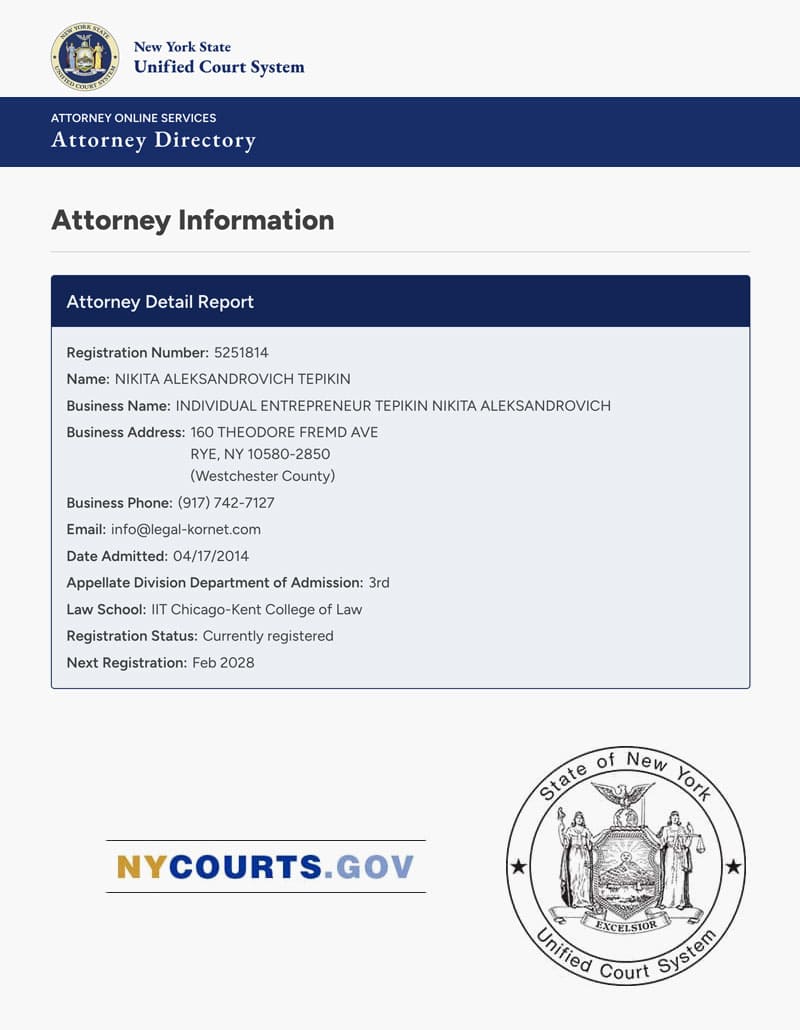
Our lawyers are licensed in the State of New York, USA

First Name: Nikita
Last Name: Tepikin

Registration number: 5251814

You can verify this license via the New York State Unified Court System attorney directory.
Key Terms and Conditions

Each clause below carries legal, operational, and commercial implications. Gaps or inconsistencies between the contract, whitepaper, tokenomics, and marketing materials are one of the most common sources of post-deal disputes and regulatory risk.

A strong agreement should clearly separate commercial terms, legal representations, technical delivery mechanics, and post-closing restrictions, reducing ambiguity around how token purchasers receive, hold, use, or transfer the tokens after delivery.

Key clauses usually include the following.

Token Allocation and Purchase Price

The agreement should clearly state the number of tokens being purchased, the price per token, the total purchase amount, token price adjustments, accepted payment currency, and payment deadline.

For crypto payments, it may also need to address wallet addresses, exchange rates, transaction confirmation, failed payments, gas fees, and refund mechanics.

Token Delivery and Mechanics

Delivery and initial distribution should be documented precisely.

The agreement should state whether tokens are delivered immediately, after a Token Generation Event, after mainnet launch, after public sale completion, after KYC approval, or after another milestone.

It should also explain whether delivery happens through a smart contract, manual wallet transfer, exchange account, vesting dashboard, token minting protocol, or another delivery mechanism.

Unclear delivery mechanics often create disputes with investors and can create problems when the project later prepares for exchange listing or distribution.

Lock-Up and Vesting

Lock-up and vesting terms are critical in token sales.

They can help reduce short-term dumping risk, align early and future holders with the project’s long-term development, and create a clearer release schedule.

The agreement may include:

  • Cliff periods;
  • Linear vesting;
  • Monthly or quarterly unlocks;
  • Transfer restrictions before unlock;
  • Restrictions around exchange listing, token launch, or TGE;
  • Consequences for breach of lock-up.

These terms are not only commercial. They may also affect investor expectations, tokenomics credibility, and the project’s legal positioning.

Buyer Representations

The purchaser should usually confirm key facts, such as:

  • They are not located in a restricted jurisdiction;
  • They are not subject to sanctions;
  • They are purchasing for permitted purposes and are eligible to purchase tokens;
  • They understand the risks of digital assets;
  • They are not relying on guaranteed profit statements;
  • They have provided accurate KYC/KYB information;
  • They have authority to enter into the transaction.

For institutional or private rounds, the agreement may also include accredited investor, professional investor, qualified investor, or similar status confirmations depending on the jurisdiction.

KYC, AML and Sanctions

Modern token sales cannot treat KYC/AML as an afterthought.

The agreement should work with the project’s onboarding process, wallet screening, sanctions controls, source of funds checks, and investor eligibility rules.

For higher-risk transactions, the legal documents may need to be aligned with on-chain analytics, wallet whitelisting, internal compliance procedures, and exchange requirements.

Risk Disclosures

The agreement should include clear risk disclosures.

These may cover:

  • Token volatility;
  • Regulatory uncertainty;
  • Technology and smart contract risks;
  • Market liquidity risks;
  • Tax risks;
  • Exchange listing uncertainty;
  • Project development risks;
  • Loss of private keys;
  • Blockchain network risks and risks related to underlying blockchain technologies.

The goal is not to scare the purchaser. The goal is to avoid misleading expectations and to make sure the purchaser understands the nature of the transaction.

No Guarantee of Profit or Listing

This is one of the most sensitive areas.

A token sale document should avoid language that suggests guaranteed profit, guaranteed listing, guaranteed liquidity, buyback promises, fixed returns, or appreciation in token value.

In the Munchee case, the SEC focused heavily on the expectation of profits and the way buyers were led to expect that the team’s efforts would increase the token’s value. This remains a useful warning for sale structuring and marketing language.

Governing Law and Dispute Resolution

The agreement should define governing law, forum, dispute resolution procedure, notice mechanics, and the entire agreement terms between the parties.

For cross-border sales, this is especially important because the issuer, purchaser, token holders, exchange venues, and payment flows may all be connected to different jurisdictions.

How We Work and What You Receive

We follow best practices for token sale documentation and tailor each agreement to the specific transaction. We review the transaction structure, token utility, purchaser profile, jurisdictional exposure, and project materials so the document reflects the real transaction.

The result is a clean, investor-ready document set you can use in your round. Depending on the scope, the engagement usually covers:

Drafting from scratch

A full agreement tailored to your token model, tokenomics schedule, and whitepaper, with investor-ready terms.

Review and risk cleanup

Examining existing documents and removing risky investment-style language, weak restrictions, and inconsistent terminology.

Buyer protections and compliance

Buyer representations and restrictions, plus KYC/AML, sanctions, and source of funds provisions.

U.S. securities alignment

Aligning contract terms with the Howey test and the SEC/CFTC interpretive guidance (Release 33-11412).

SAFT and Warrant coordination

Aligning the agreement with related SAFTs, Token Warrants, Token Side Letters, and investor documents.

Exchange readiness

Structuring lock-up, vesting, and delivery mechanics and supporting listing documentation.

Request a Token Sale Agreement Review

Getting ready to raise? Whether it’s a private round, a strategic allocation, a launchpad sale, or a tokenized-asset deal, the contract behind it should be in place before any money moves, not patched together once commitments are made.

Send us your draft for a review, or have us build one from scratch. We’ll structure the deal, strip out the language that creates legal risk, and hand back documentation you can put in front of investors with confidence.

Reach out to Legal Kornet to get started.

Crypto Law Experts

Deep specialization in crypto law and an insider’s understanding of blockchain regulation.

Jurisdictional Reach

Extensive experience handling global regulatory environments for crypto projects.

Fast Delivery

Efficient delivery timelines, with expedited options available when needed.

Custom Analysis

Fully custom analysis written specifically for your digital asset model.

Regulatory Compliance

Legally sound documentation accepted by Tier-1 exchanges and venture capital firms.

Crypto Legal Pioneer

One of the early legal advisors in crypto — working with blockchain projects since 2016.

Proven Track Record

600+ crypto projects served, from industry leaders to emerging startups.

Trusted by Leaders

Trusted by major exchanges and leading investors across the crypto space.

Read our F.A.Q.

Is a Token Sale Agreement the same as a SAFT?

No. A SAFT is usually used at an early stage, before the token or network is live. Investors pay now for a contractual right to receive tokens later. A Token Sale Agreement is broader: it can be used when tokens already exist, when delivery is tied to a Token Generation Event, or when the project is making a direct sale or strategic allocation. The right instrument depends on the project stage, token functionality, purchaser profile, and delivery mechanics, and we can help determine whether your transaction is better structured as a Token Sale Agreement, a SAFT, a Token Warrant, or another instrument.

Do I need a Token Sale Agreement if my token is already live?

Often, yes. If you are selling or allocating tokens to investors, strategic partners, market makers, liquidity providers, or other purchasers, you should document the transaction properly.

Can a Token Sale Agreement reduce securities risk?

A well-drafted agreement can help reduce avoidable risk by aligning the transaction with the project’s legal position, removing problematic language, adding restrictions and disclosures, and avoiding profit-promising terms. However, no agreement can guarantee that a token will not be treated as a security.

Can Legal Kornet assess our existing Token Sale Agreement?

Yes. We can assess existing token sale documents, identify legal risks, suggest revisions, and align the agreement with your whitepaper, website, tokenomics, and legal opinion position.

Can a Token Sale Agreement be used for a public token sale?

Yes, but the structure must be reviewed carefully. A public token sale may involve additional legal, disclosure, marketing, investor eligibility, and jurisdictional issues. The agreement should match the public sale mechanics, token delivery process, and restrictions that apply to the relevant markets.

Is a Token Sale Agreement enough to launch a token?

Not always. A Token Sale Agreement is only one part of the legal setup. Before launch, you may also need token classification analysis, risk disclosures, KYC/AML procedures, website disclaimers, whitepaper review, tokenomics review, and legal support for the issuance process.

Can Legal Kornet help with SAFTs and Token Warrants too?

Yes. We assist with SAFTs, Token Warrants, Token Purchase Agreements, Token Side Letters, investor questionnaires, token legal opinions, and related Web3 fundraising documents.


Our Clients & Partners

Kaspa
BigOne
BTCC
Waves
ApeCoin
Floki
BitMart
INXY
KuCoin
KGEN

Contact Us

You could ask us any questions. Anyway you prefer:
Want to learn more? Drop us a line!
Contact Us (Footer)